Chế Biến Mật Ong (Honey): Cầu Nối Hương Vị
Updated: 6/15/2026
Semi-washed
Lam Dong Market
Dữ liệu chính thức
Arabica Reference Price
89,600đ/kg₫/kg
0
The Honey process (or semi-washed) is a hybrid between Natural and Washed methods. Despite the name, no actual honey is used. The name comes from the sticky, honey-like texture of the sugar-rich mucilage (pectin) that coats the coffee bean after the outer skin is pulped.
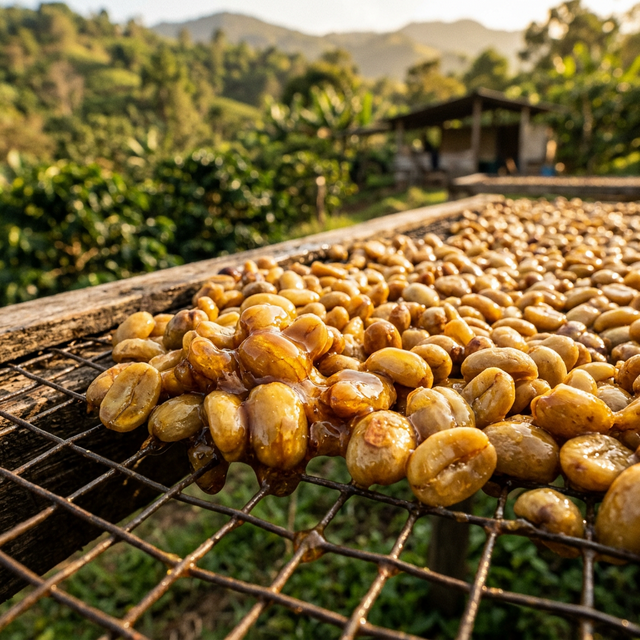
Coffee beans with sticky mucilage drying on mesh beds.
1. Bản chất lớp nhầy (Mucilage) và tỷ lệ giữ lại
The core principle of the Honey Process is controlling the amount of mucilage retained on the bean's surface during drying. The more mucilage left, the stronger the fermentation, allowing more sugars to penetrate the green bean, thus creating different Honey levels.
| Honey Level | Mucilage % | Avg. Drying Time |
|---|---|---|
| White/Yellow Honey | 10% - 50% | 8 - 10 days |
| Red Honey | 50% - 80% | 10 - 15 days |
| Black Honey | 80% - 100% | 15 - 20+ days |
2. Các cấp độ Honey: Từ White đến Black
Black Honey is the most difficult and time-consuming method. Retaining 100% mucilage means a very high risk of mold. Farmers must constantly rake the beans on drying beds under various shade covers to control heat and humidity. Conversely, White/Yellow Honey is dried under stronger sun, drying faster and resulting in a lighter color.
Environmental Impact
Despite being difficult, the Honey process consumes significantly less water than Washed (only depulping without washing), making it very environmentally friendly.
3. Tác động đến hương vị (Flavor Profile)
The Honey process creates a beautiful balance: the clarity and cleanness of Washed, combined with the heavy sweetness, thick body, and fruit notes of Natural.
Bản giao hưởng độ ngọt
The darker the 'Honey' (Black/Red), the more syrupy sweet the cup, with a heavier body and complex profile. White/Yellow highlight balance and cleanness.